|
|
|
Bracket Check: Who's Up? Who's Down? (Jan. 26)
|
|
Checking in on bracket projections after a wild week in college basketball, including a historic Saturday slate that saw three freshmen score 40-plus points, multiple huge road upsets, and dozens of thrillers across the board.
|
|
North Carolina won at Virginia. Auburn knocked off Florida. Tennessee took down Alabama. Those results alone forced movement across seed lines and bracket resumes.
|
|
Below, we sort the chaos into three buckets: the teams climbing fast, the ones slipping at the worst possible time, and the situations worth watching closely as the margins between seeds, bubbles, and bid thieves continue to shrink.
|
|
|
|
|
|
5 Risers: Teams Making Real Moves
|
|
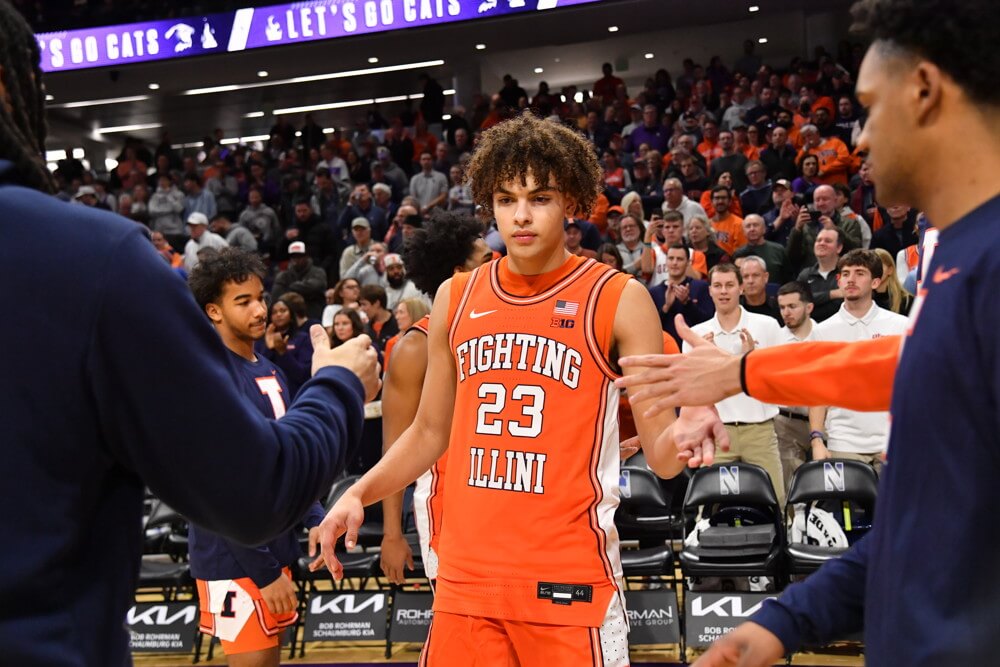
1. Keaton Wagler’s breakout elevates Illinois
|
Five days ago, Keaton Wagler was a solid freshman shooting just over 41 percent from the field, coming off a 1-for-9 night from three against Maryland and barely on the national radar.
Then he dropped 46 points on the road at Purdue.
It was the most points ever scored against a top-10 team on the road in college basketball history.
He is now being discussed as a potential top-five NBA Draft pick.
TeamRankings’ Win Score ranks Wagler as the sixth most valuable player in Big Ten conference play. |
|
2. Auburn’s surge pulls the Tigers off the bubble
|
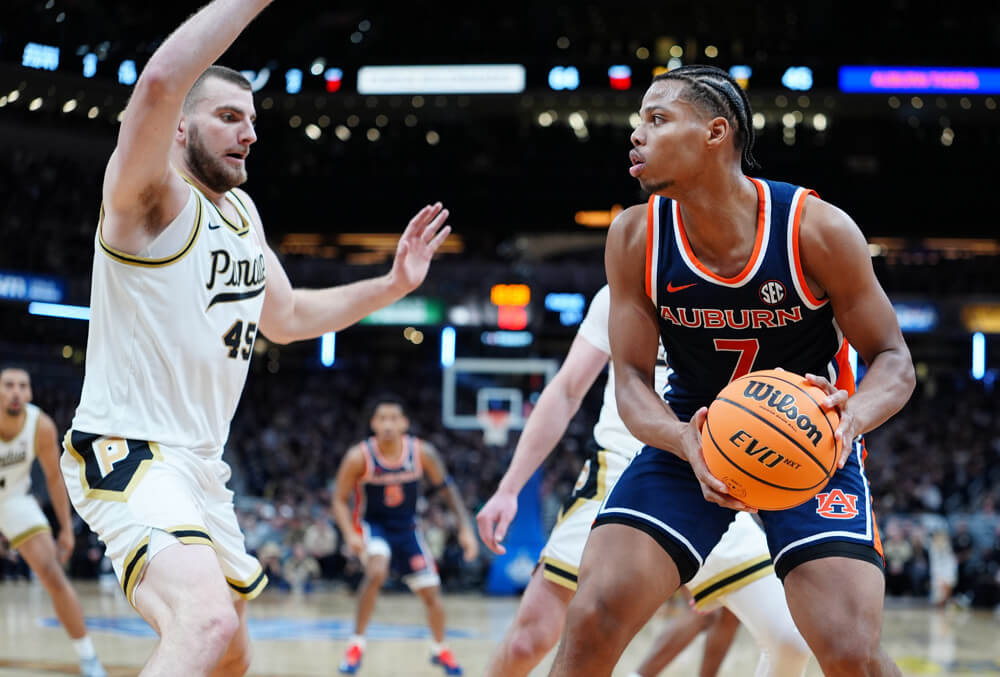
Auburn has won three straight SEC games, two on the road, capped by a nine-point upset of Florida as an 11.5-point underdog.
After a 1-3 conference start had the Tigers sliding toward the bubble, TeamRankings now projects a 12-6 SEC finish. Only three remaining games give Auburn less than a 50 percent win probability, all on the road. |
|
3. North Carolina gets its season-defining road win
|
North Carolina’s bracket position leaned heavily on a November home win over Kansas until now.
After opening conference play 0-3 in Quad 1 games, the Tar Heels delivered a defining road win at Virginia. That result moved UNC up the seed line and removed any lingering questions about whether this team belongs among the top tier. |
|
4. Texas A&M’s rise to the top of the SEC
|
Texas A&M was 2-2 in early November after blowout losses to Oklahoma State and UCF.
Since then, the Aggies are 14-2, with both losses coming to Quad 1A opponents and five wins against Quad 1 or Quad 2 teams. They now sit alone in first place in the SEC.
TeamRankings gives Texas A&M the third-best odds to win the conference, trailing only Florida and Arkansas. |
|
5. The two seed line nearly breaks
|
Full seed-line swaps are rare, but we nearly saw one this week.
Nebraska held the two line, but Gonzaga jumped Purdue after two losses. Michigan State passed Houston following a road loss at Texas Tech. Illinois surged to the two line after Keaton Wagler’s breakout.
The two seed line did not flip completely, but it came close, a clear sign of how tight the margins have become. |
|
|
|
|
|
|
|
5 Fallers: Teams Losing Ground
|
|
1. Baylor free-falls out of the picture
|
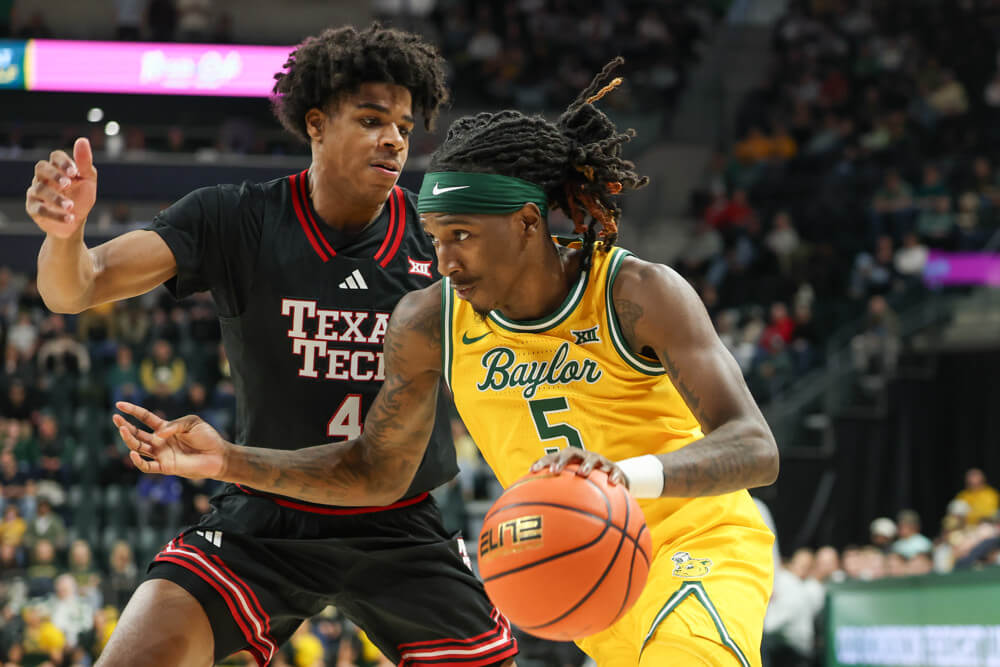
No team took a bigger hit this week than Baylor.
The Bears’ tournament odds cratered from 37.1 percent to 12.1 percent after a single week. They now sit at 1-6 in conference play and rank as the most underperforming team in the country relative to expected success against quality opponents.
Time is quickly running out. |
|
2. Seton Hall’s collapse after a dream start
|
Seton Hall was 14-2, projected as a seven seed, and one of the few bright spots in an otherwise underwhelming Big East season.
Since then, everything has unraveled. The Pirates have lost four straight and now sit outside the tournament field, looking in with little margin left to recover. |
|
3. The Mountain West is trending toward a one-bid reality
|
As things stand, only three Mountain West teams remain in realistic at-large contention: Utah State, San Diego State, and New Mexico. Even that group looks increasingly fragile.
Utah State took a forgivable Quad 1 loss to Grand Canyon, then followed it with a damaging Quad 3 home loss to UNLV before rebounding against Colorado State. In the span of a week, the Aggies went from near-lock territory to squarely on the bubble.
San Diego State re-entered the tournament picture after opening conference play 7-0, but a loss to Grand Canyon on Wednesday complicated an already thin resume.
New Mexico went 2-0 this week, but still owns just one Quad 1 win paired with a Quad 3 loss. That profile keeps the Lobos firmly on the bubble, and possibly on the wrong side of it.
Taken together, the Mountain West is at real risk of becoming a one-bid league, a stunning fall from grace after sending six teams just a few seasons ago. |
|
4. Stanford’s margin disappears fast
|
Stanford lost the battle of California at home on Saturday, and the damage was immediate. TeamRankings now gives the Cardinal just a 16 percent chance to make the tournament, despite a solid 4-2 record in Quad 1 games.
The issue is volume. Without enough quality wins left on the schedule, there is little room for error. |
|
5. Dayton’s disastrous road week
|
Dayton entered last week undefeated in A-10 play and firmly in the at-large discussion.
That changed quickly. The Flyers went on the road and fell behind La Salle, ranked 227th in the NET, by a stunning 33-8 margin in the first 11 minutes. A comeback followed, but the loss stood. Any chance to stabilize disappeared two days later with an 81-74 loss at Saint Joseph’s, ranked 182nd in the NET.
Week over week, TeamRankings dropped Dayton’s tournament odds by 17.2 percent, the second-largest decline in the country. |
|
|
|
|
|
|
|
Are We Looking at Another Historically Strong Top Tier?
|
|
The numbers say this year looks elite at the top
|
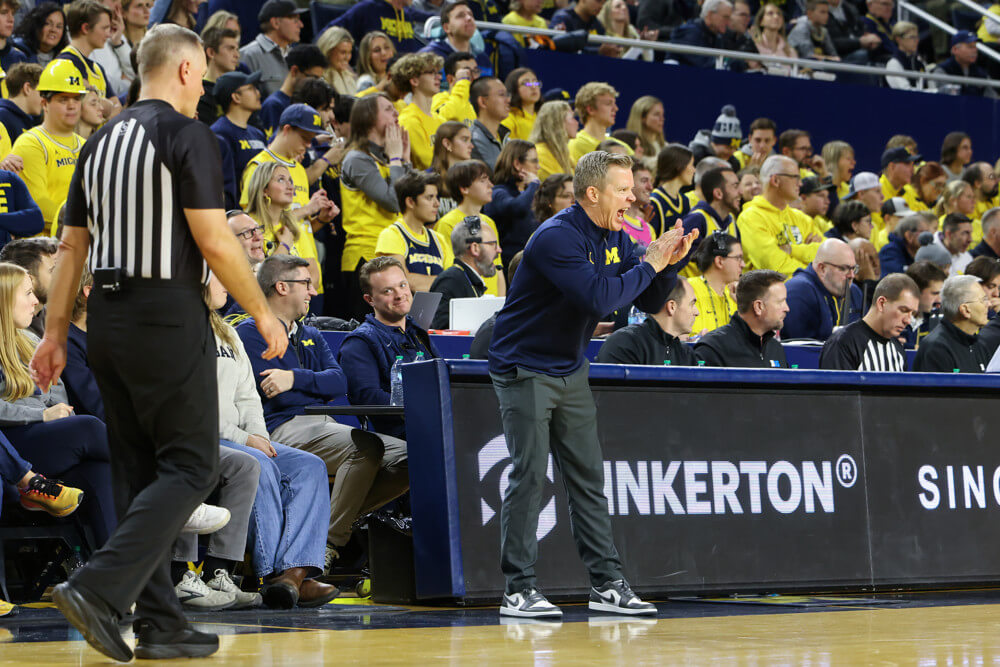
According to TeamRankings power ratings, the 2025–26 season is tracking similarly to last year’s historically strong group. As of January 26, Michigan leads the country at 27.8, essentially matching last season’s elite ceiling.
What stands out more is the depth. The average rating of the current top 10 sits at 23.6, with a median just over 23.0. Even the 10th-ranked team, UConn, is still above 21.0, a sign that the separation is real and sustained. |
|
Depth, not just a single dominant team
|
This is not a case of one runaway favorite. The strength carries across the entire top tier, with teams clustered tightly from No. 1 through No. 10.
In most seasons, the drop-off after the top few teams is sharp. Last year was different, and this season is beginning to resemble that same profile rather than a typical, flatter distribution. |
|
Historical context shows why this matters
|
Recent seasons generally produced top-10 medians in the high teens or low 20s. Last year stood out because the strength extended cleanly through the top 10.
This season is closer to that outlier than to the norm, at least at this stage of the calendar. |
|
The transfer portal connection
|
This trend continues to support a broader hypothesis: the transfer portal is benefiting the top programs more than the field as a whole. When talent moves freely, the most established teams are best positioned to consolidate it quickly.
That concentration shows up directly in the ratings. When the top tier is this strong, it is rarely accidental. |
|
What it means for March
|
Historically strong top tiers tend to be more resilient to variance and less dependent on favorable draws. If this pattern holds, it suggests fewer true long-shot champions and a higher likelihood that the eventual winner comes from this concentrated elite group.
Last season may not have been the exception. It may be the beginning of a trend. |
|
|
|
|
The Best Way to Follow College Hoops
|
|
|
College basketball is noisy. Even if you watch every game, perception and media narratives rarely line up with what the numbers are showing.
This newsletter breaks down the season through the data, highlighting where teams may be stronger or weaker than they appear so you have a clearer view before March. |
|
|
|
|
|
|
|
|
|