|
Kansas Is Winning, But the Darryn Peterson Numbers Are Complicated
|
Late Monday night, Kansas found themselves down 61-56 on the road vs. Texas Tech with 2 minutes left. Darryn Peterson, through 38 minutes, was 3-of-12 from the field, 1-of-7 from deep with only 13 points.
At that time, curiosity struck me: What do the numbers say about Peterson's contributions? With the help of TeamRankings and CBB Analytics, I found some interesting splits on Kansas' efficiency with Peterson on/off the floor.
And just as I was researching those numbers, Peterson hit two unbelievable, clutch three-pointers to steal a road win for his team in true superstar fashion.
So even though he was dubbed a hero in the headlines, the broader numbers tell a much more complicated story. |
|
Top 10 Lineups in Conference Play
|
|
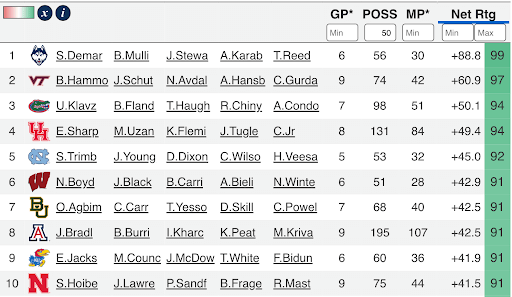
Below is a chart from cbbanalytics.com showcasing the top 10 lineup combinations in college basketball during conference play, based on adjusted overall NET efficiency.
|
|
|
|
Kansas has a lineup featured in this Top 10, yet superstar Darryn Peterson is not in it. Interesting.
|
|
Kansas’ Best Lineup = No Peterson?
|
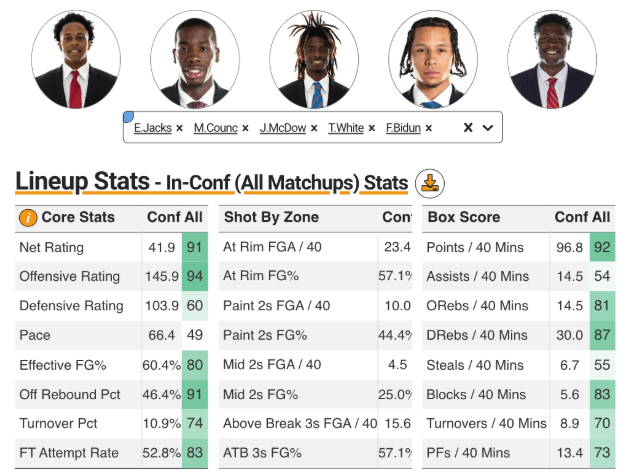
The lineup of Elmarko Jackson, Melvin Council Jr, Jamari McDowell, Tre White and Flory Bidunga has an overall NET rating of +41.9 across 36 minutes of play. They score 145.9 points per 100 possessions and allow just 103.9. |
|
|
|
What About Kansas’ Main Starting Lineup?
|
|
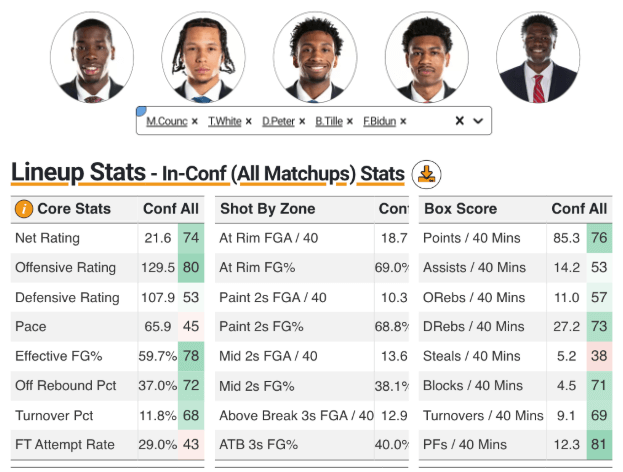
Kansas’ main starting lineup featuring Council, White, Peterson, Tiller and Bidunga gets most of the minutes when all five are healthy, as Kansas doesn’t dive deep into their bench much.
|
|
|
This lineup is efficient, which makes sense given Kansas is 17-5 (7-2) and ranked 11th in the AP Poll, but from a statistical standpoint it’s not their most effective lineup. However, a difference between a lineup in the 91st percentile and 74th percentile with sample sizes restricted to conference play only isn’t drastic enough to draw major conclusions, especially when both lineups are clearly productive.
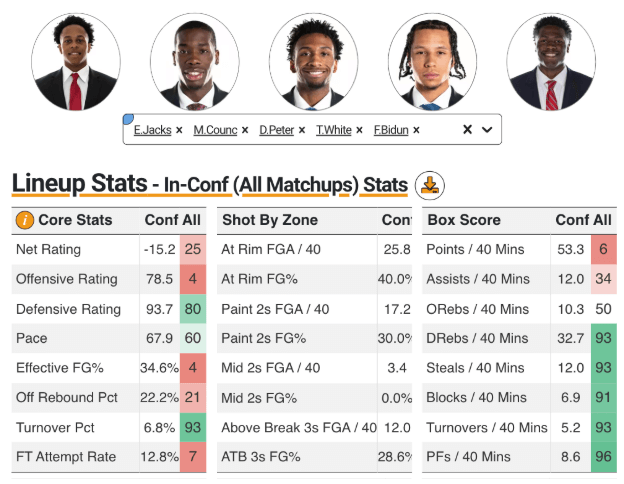
However, when looking at Kansas’ LEAST efficient lineup (minimum 30 minutes played), the margins pop off the screen in a way that cannot be ignored. |
|
|
|
Elmarko Jackson, Melvin Council Jr, Darryn Peterson, Tre White and Flory Bidunga have a NET rating in the 25th percentile and are scoring just 78.5 points per 100 possessions, which places them in the 4th percentile.
|
|
TeamRankings Data Tells a Similar Story
|
Team Rankings backs up this data, especially when comparing Darryn Peterson to fellow highly touted NBA Draft prospects. Based on ‘Win Score’ rankings at Teamrankings.com, Cameron Boozer ranks 1st in the nation, Caleb Wilson is 3rd, yet Peterson is nowhere to be seen.
Pivot the data set to ‘Game Score’, and you find (among freshmen):
#1 - Cameron Boozer
#2 - Caleb Wilson
#3 - AJ Dybantsa
#18 - Darius Acuff
#27 - Darryn Peterson
#29 - Keaton Wagler |
|
Peterson’s Stats Don’t Match Lineup Impact
|
|
Peterson’s production is remarkable, he’s averaging 21 points and 4 rebounds, shooting 49% from the field and 43% from deep, yet his output doesn't fully correlate with team success as much as other prospects.
|
|
Is this a cause for concern in the context of Peterson’s ability to thrive in the NBA? Probably not, as Peterson is obviously a superhuman talent. The fact that there’s something not fully clicking yet within the Jayhawks roster efficiency is telling of many things, but it’s mostly just an interesting note.
|
|
This Has Happened with Similar Prospects
|
We’ve seen this in the past with college talents that are almost “too good” for college basketball. • Ben Simmons wasn’t able to will LSU to the tournament in 2016. • Trae Young put up outstanding numbers at Oklahoma, yet his team snuck into the tournament as a 10 seed and lost in the first round. • Dylan Harper and Ace Bailey, two top 5 picks, couldn’t even sniff a tournament berth for Rutgers last year. None of the aforementioned names were featured on Teamrankings ‘Win Score’ season long leaderboard. That's mostly because if you put up big numbers but the team isn’t winning, the stats aren’t truly correlated to team success. |