Kansas as a 1 Seed? Only Under RPI

Published: Thu, 02/12/26

Updated: Thu, 02/12/26

What the Bracket Would Look Like If RPI Still Ruled
The NCAA replaced RPI with the NET before the 2018-19 season.

Back then, a team’s resume was largely boiled down to one number. RPI combined winning percentage, opponents’ winning percentage, and opponents’ opponents’ winning percentage into a rating between 0.00 and 1.00 that compounded over the course of the season. It was simple. It was clean. It was also flawed.

The NET has its issues, but it is widely viewed as a far better evaluation tool.

Still, the question is too fun not to ask. What if the NET did not exist? What if we were living in 2015. Or even 1985.

TeamRankings still calculates RPI, noting that it provides a useful comparison point to the NET. So let’s use it. Here is what the bracket would look like right now if RPI alone determined seeding.
1 Seeds
Michigan 0.687
Arizona 0.680
Duke 0.676
Kansas 0.669

2 Seeds
UConn 0.664
Texas Tech 0.656
Houston 0.653
North Carolina 0.650
It is not officially confirmed that the Selection Committee strictly seeded by RPI in the past. Many believe metrics like KenPom, Sagarin, and BPI were quietly used for admission decisions. But for the purpose of this exercise, we are assuming RPI was the driving force.

And with that assumption, wow.

Kansas would be in great shape for a 1 seed. North Carolina and Texas Tech would be firmly on the 2 line. That is a remarkable difference from where things stand in 2026.

The biggest reason is simple. RPI does not factor in margin of victory. Texas Tech losing to Purdue by 30 does not meaningfully hurt them. If anything, it may slightly help because it was a neutral site game against a strong opponent.

Under RPI, who you play and whether you win matters far more than how you look doing it.
3 Seeds
Purdue 0.649
Alabama 0.644
Illinois 0.642
Michigan State 0.641

4 Seeds
Florida 0.641
Nebraska 0.638
Vanderbilt 0.636
Iowa State 0.635
This section is less absurd, especially on the 3 line.

Alabama is ranked 20th on KenPom and 23rd in the NET, which is why they are currently viewed more as a 5 seed. But they have six Quad 1 wins and a 12-7 record against the top two quadrants. On pure resume terms, that correlates more closely with a 3 or 4 seed.

Illinois, Purdue, and Michigan State as 3 seeds is a completely reasonable projection. Florida and Vanderbilt on the 4 line feels fair. Iowa State and Nebraska might even be slightly disrespected.

The point here is important. RPI does not blow up the bracket. It just shifts certain teams across seed lines.
5 Seeds
Utah State 0.633
Arkansas 0.633
Saint Louis 0.630
BYU 0.629

6 Seeds
St John’s 0.624
Gonzaga 0.621
Louisville 0.621
UCF 0.621
This is where it gets fascinating.

Utah State and Saint Louis have played easier schedules, but their winning percentages are so strong that RPI rewards them heavily. Stack wins and you climb.

Gonzaga, on the other hand, feels like they should benefit from similar logic. But a loss to a 10 to 14 Portland team carries more weight under RPI than it does today as a Quad 3 blemish.

Under this system, bad losses sting more than inefficient wins.

Top College Basketball Picks This Weekend (Feb 13-15)

Best College Basketball Bets

Watch as we run through our College Basketball predictions for the top games this weekend (Feb. 13-15).

WATCH NOW
7 Seeds
Virginia 0.620
Saint Mary’s 0.619
Villanova 0.615
SMU 0.611

8 Seeds
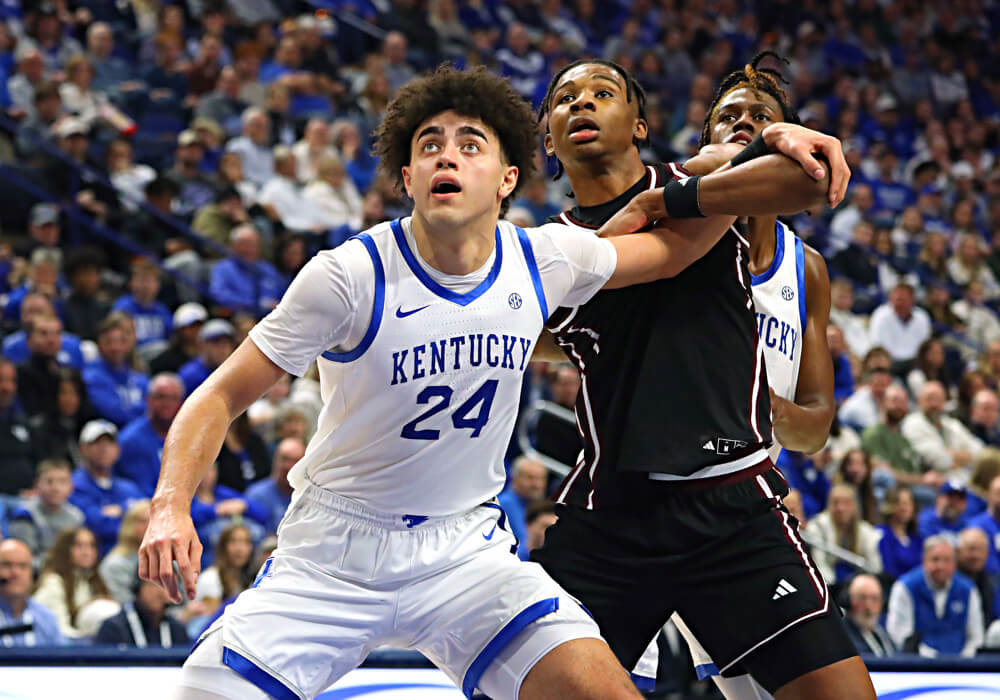
Kentucky 0.611
Tennessee 0.609
Santa Clara 0.609
Auburn 0.607
This is where the philosophical differences really start to show.

Virginia drops from a sturdy 4 seed projection into the 6 or 7 range. Meanwhile, Saint Mary’s and Santa Clara would be sitting comfortably in the field instead of hovering around the bubble.

RPI leans heavily on record and opponent win percentage. Efficiency heavy evaluations that boost certain power conference teams simply do not exist here.

Under this system, stacking wins matters more than looking dominant.
9 Seeds
NC State 0.607
Clemson 0.604
Miami OH 0.601
Boise State 0.600

10 Seeds
Virginia Tech 0.597
George Mason 0.592
USC 0.591
Liberty 0.590
The bubble would look dramatically different.

Miami Ohio at 24-0 would be nowhere near the cut line. Boise State, despite a Division II loss and a résumé that does not scream lock, would be a single digit seed.

George Mason and Liberty, who realistically have almost no at-large path right now, would be in the field.

The selection show reaction would be loud.
Safe 11 Seeds
VCU 0.590
Wisconsin 0.590

Play-In 11 Seeds
San Diego State 0.590
Indiana 0.588
Nevada 0.588
Iowa 0.587
Ignoring the fact that some of these teams would secure automatic bids, this would be your at-large cutoff under a pure RPI world.

That means no Texas A&M. No Georgia. No UCLA. No Miami. No Texas.

Iowa as the final team in behind Nevada would cause an uproar. Wisconsin drawing Gonzaga as an 11 seed after road wins at Michigan and Illinois would not go over well in Madison.

There would be more mid-major representation, but also far more power conference outrage.
The Field Isn’t That Different, The Seeds Are
When you zoom out, the actual list of teams in the field is not wildly different from current NET projections.

The biggest change is drastic movement across seed lines rather than egregious snubs or shocking inclusions.

Should RPI return next year? No. Logic suggests that would not be wise.

But having access to the data is undeniably fascinating, and it is a clear reminder of how much the evaluation process has evolved from simply asking who you beat to digging deeper into how you performed.

The Best Way to Follow College Hoops

CBB By the Numbers

College basketball is noisy. Even if you watch every game, perception and media narratives rarely line up with what the numbers are showing.

This newsletter breaks down the season through the data, highlighting where teams may be stronger or weaker than they appear so you have a clearer view before March.
Join Here


111 S Highland Avenue #458
Memphis TN 38111
US


Unsubscribe   |   Change Subscriber Options